
Walk far enough west across Spain and the Camino de Santiago does something most roads never do. It ends. Not at a city or a cathedral, but at the water, on a granite shelf the Atlantic has been polishing since long before anyone thought to call it holy. Medieval pilgrims believed this was the edge of the known world. They were not entirely wrong.
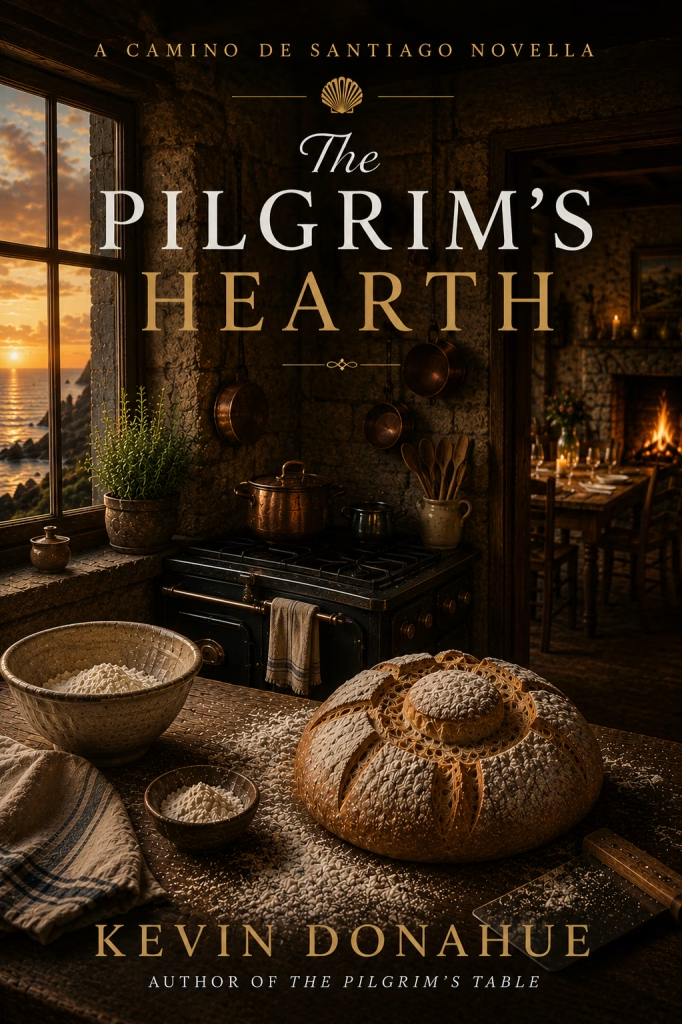
That place is real. It is called Muxía, a fishing village on the Costa da Morte, the Coast of Death, named for the ships the sea has taken. It is where my novel The Pilgrim’s Table is set, and it is where its new prequel, The Pilgrim’s Hearth, begins to make sense of the one character readers ask me about most.
Not a pilgrim. The man who feeds them.
The Pilgrim’s Hearth is a free download for subscribers of the Pilgrim Newsletter and available for purchase on Amazon.com
The one who never walked
In The Pilgrim’s Table, five strangers arrive at a small inn called Chez Mer at the end of their separate journeys along the Camino de Santiago. Each has walked a different route. Each is carrying something they have not yet set down. They are met by Matthieu, a French chef who left a celebrated kitchen to cook for travelers at the edge of the ocean.
Here is the quiet fact that drives the whole series. Matthieu is the only person at that table who has never walked the Camino. Five pilgrims sit down to a meal prepared by a host who has spent years watching pilgrims arrive and has never once been one.
Readers noticed. The question I have heard more than any other since the book came out is some version of: ” Where did he come from? How does a decorated chef end up keeping the light on in a village most maps forget?”
The Pilgrim’s Hearth is the answer.
A road that runs the other way
The prequel does not start on the Camino. It starts in a kitchen in Vézelay, France, where Matthieu has gone to recover from the discovery that he has climbed the wrong mountain in his life. His grandmother walked the Camino in her youth. She sends him to Spain with a few quiet words and an old kitchen knife, and at the door she says something that startles him, because he is certain he is not going on any pilgrimage at all.
He goes only to watch. He stands in the great square in Santiago de Compostela in the rain and watches the pilgrims arrive at the Pilgrim’s Reception Office and the cathedral steps, and what he sees there begins to undo him. People who have stopped performing. People laughing and weeping at the same time, and not minding which. He has spent a career feeding diners who derive pleasure at great expense. He has never seen anything like a square full of people who have walked the performance off somewhere back along the road.
From Santiago, the road runs west, past Finisterre, all the way to the water. To a cold parish house no one wants, a hundred-year-old table that has heard every word a village ever needed to say, and a hearth that has not been lit in years.
The fire that was already there
I want to tell you about that hearth, because writing it taught me what the book was about.
The fireplace Matthieu inherits has been dark for a long time. A bird had nested in the flue. The stone had gone grey with old ash. The last priest let it go cold when the parish emptied, and it sat dead through who knows how many winters. Matthieu clears it by hand. He scrubs the firebox down to the stone. And the first night the fire catches and stands up clean and takes the chill out of the room, the house seems to exhale.
He does not arrive to build something new. He arrives to relight something that was always meant to burn.
A lit fire in a window is one of the oldest signals human beings have. It does not say welcome the way a set table does. It says something older. It says you were welcome before you arrived, that the house knew you were coming even before it knew your name. That is what his grandmother sent him to remember. Not how to cook. He already knew how to cook. She sent him to remember who it was for.
Two kinds of pilgrimage
Most pilgrimage stories belong to the person on the road, and rightly so. If you have walked the Camino, or you are planning to, you know that story in your body. (If you are still planning, American Pilgrims on the Camino and the Pilgrim’s Office are the places I send people first.)
But every road has someone waiting at the end of it. Someone who keeps the bread ready and the room made up and the fire lit when a tired stranger comes over the last hill in the dark. We rarely ask about that person. We are too grateful to be let in.
The Pilgrim’s Hearth is for that person, and about them. It is the story of the man who never walked, and how he learned that some of us are called to the road, and some of us are called to keep the fire for those who walk it.
Both are pilgrimages. I am more sure of that now than I was when I started.
The Pilgrim’s Hearth is a prequel to The Pilgrim’s Table, the first novel in the Camino Chronicles. You can read it before the novel or after. Read first, it tells you who is waiting at the end of the road. Read after, it tells you how the table you have already sat at came to be set. Learn more about the book at thepilgrimstable.com, and hear pilgrims tell their own stories on the Sacred Steps podcast.
The Pilgrim’s Hearth is a free download for subscribers of the Pilgrim Newsletter and available for purchase on Amazon.com
Buen Camino.
Share this post
#ThePilgrimsHearth #ThePilgrimsTable #CaminoDeSantiago #BuenCamino #Muxia #CostaDaMorte #CaminoChronicles #PilgrimageStories #LiteraryFiction #SacredSteps #EndOfTheWorld #CaminoFinisterre #BookLovers #IndieAuthor
